
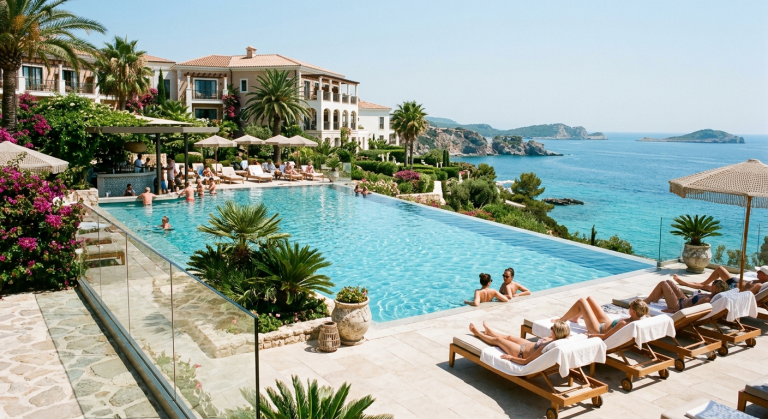
Hotel swimming pool construction in Mussoorie requires hill-specific engineering — including geotechnical soil surveys, retaining walls, freeze-resistant plumbing, and reinforced waterproofing — to withstand the region’s steep terrain and cold winters. A typical project takes 3–5 months and costs vary based on pool type, terrain difficulty, and finish quality. Hiring a contractor experienced in hill-station projects, similar to those handling Hotel Swimming Pool Construction in Mussoorie is essential for a safe and long-lasting result.
Mussoorie, known as the “Queen of the Hills,” welcomes travellers throughout the year — honeymooners in spring, families in summer, and leaf-peepers in autumn and winter. For hotel owners in this hill station, a well-built swimming pool has become one of the most effective ways to stand out, justify premium tariffs, and keep guests booking longer stays. But building a pool on Mussoorie’s steep, rocky terrain is fundamentally different from constructing one in the plains, and getting it wrong can be an expensive mistake. This guide covers everything a hotel owner needs to know about hotel swimming pool construction in Mussoorie, from initial planning to long-term maintenance.
What is Hotel Swimming Pool Construction?
Hotel swimming pool construction is the complete process of designing, engineering, and building a pool for a hospitality property. It covers site survey and soil testing, structural engineering, waterproofing, plumbing, filtration and heating systems, tiling or lining, and safety compliance. For hill destinations, this process is considerably more complex than standard hotel swimming pool construction on flat ground, because of sloped land, mixed soil and rock composition, and extreme seasonal weather.
Why are Hotels in Mussoorie Investing in Swimming Pools?
A swimming pool delivers measurable business value for hotels in this market:
| Benefit | Business Impact |
|---|---|
| Premium positioning | Justifies higher room tariffs and resort-level pricing |
| Longer guest stays | Increases food, beverage, and spa revenue per guest |
| Social media visibility | Valley-view and infinity pools drive free organic marketing |
| Off-season appeal | Heated pools sustain bookings through Mussoorie’s colder months |
| Competitive edge | Differentiates from the many Mussoorie hotels without pools |
Booking platforms consistently show that “does it have a pool” is one of the most common filters travellers apply when searching for hotels in Mussoorie, which means a pool can directly influence visibility and conversion on OTA listings, not just guest experience.
What Makes Pool Construction in Mussoorie Different From the Plains?
Mussoorie’s hilly terrain creates challenges that don’t exist in standard construction projects:
-
- Sloped and terraced land – Most hotel plots are built on slopes, requiring retaining walls, stepped excavation, or cantilevered structures to create a level pool base.
-
- Mixed rock and soil composition – The Himalayan foothills often combine loose soil with rock strata, making a geotechnical survey essential before excavation begins.
-
- Limited water supply – Water scarcity in hill areas means pools must be designed with efficient filtration, recycling, and minimal backwash wastage.
-
- Cold winters and freeze-thaw cycles – Plumbing and waterproofing must be freeze-resistant, or pools risk cracking and leaking during winter.
-
- Heavy monsoon rainfall – Drainage systems must handle seasonal runoff without flooding the pool deck or undermining retaining structures.
-
- Difficult logistics – Narrow hill roads restrict the size of vehicles and the volume of material that can reach a site, often requiring phased delivery of cement, tiles, and equipment.
How Long Does It Take to Build a Hotel Pool in Mussoorie?
Most hotel pool projects in Mussoorie take 3 to 5 months from site survey to handover, compared to the 8–12 weeks typical of a standard plains-based commercial pool. The extended timeline in Mussoorie is due to:
-
- Slower excavation on sloped or rocky sites
-
- Weather-dependent construction windows (monsoon months often pause outdoor work)
-
- Additional structural work for retaining walls and foundations
-
- Logistics delays from narrow access roads
What Are the Steps in Hotel Swimming Pool Construction?
1. Site Survey and Feasibility Study
A topographical and geotechnical survey determines the safest location, pool orientation, and structural approach — whether an in-ground, semi-in-ground, or elevated infinity-edge design suits the site best.
2. Design and Architectural Planning
This stage covers pool shape, size, depth zones, and edge style. Infinity and zero-edge designs are especially popular in Mussoorie because the natural slope supports valley-facing views without extensive additional excavation.
3. Structural Engineering
Reinforced concrete (RCC) construction with properly engineered retaining walls is essential on hill sites to prevent soil erosion, structural shifting, and long-term instability.
4. Waterproofing and Plumbing
High-quality waterproofing membranes and freeze-resistant plumbing are non-negotiable in Mussoorie’s climate. Poor waterproofing is the single most common cause of pool failure in hill-station properties.
5. Filtration, Heating, and Automation
Sand or cartridge filtration systems, combined with UV or saltwater sanitization, keep water quality consistent. Heating — whether solar, gas, or electric — extends the usable pool season into cooler months.
6. Tiling, Lining, and Decking
Hotels can choose between traditional tiled finishes and PVC membrane liners, along with anti-skid decking and landscaping that complements the hill-station setting.
7. Safety Compliance
Fencing, depth markers, non-slip surfaces, and lifeguard provisions are necessary both for guest safety and regulatory compliance.
What Type of Pool Should a Hotel in Mussoorie Choose?
| Pool Type | Best For |
|---|---|
| Infinity/zero-edge pool | Valley-view properties wanting a signature visual feature |
| Skimmer pool | Budget-conscious builds with lower ongoing maintenance |
| Overflow pool | High-footfall resorts needing continuous filtration |
| Prefab/modular FRP pool | Sites with difficult road access, where transporting wet-construction materials is slow or costly |
Tiled Pools vs. PVC Membrane Pools
Traditional tiled pools give a classic finish but are more prone to cracking and grout failure when hill soil shifts or freezes seasonally. PVC membrane (liner) pools are increasingly chosen for hill properties because they have no grout lines, resist cracking from ground movement, and often carry manufacturer warranties of 10–12 years on water-tightness — a meaningful advantage in a freeze-thaw climate like Mussoorie’s.
Is a Prefabricated Pool a Good Option for Hill Hotels?
Yes, particularly for properties where road access is limited. Prefab FRP (fibre-reinforced plastic) pool shells are manufactured off-site and delivered in sections, cutting on-site construction time significantly compared to poured-concrete builds. This is a genuinely practical solution in Mussoorie, where narrow hill roads already limit how much material and heavy equipment can reach a site at once. The main trade-off is reduced flexibility for custom shapes compared to cast-in-place RCC pools.
What Heating Option Works Best in Mussoorie’s Climate?
For hotels wanting to keep their pool usable through the cooler months, solar water heating is often the most cost-effective long-term choice, since it reduces dependence on transported fuel or grid electricity — both more expensive in hill locations than in the plains. Gas or electric heaters install faster but carry higher recurring operating costs at altitude, so many hotels use a hybrid system: solar as the primary source, with gas or electric backup for overcast winter days.
How Much Does Hotel Swimming Pool Construction Cost in Mussoorie?
Cost is driven by four main factors:
-
- Pool size and design – infinity-edge and overflow pools cost more than standard rectangular designs
-
- Terrain preparation – steep or rocky sites increase excavation and retaining-wall costs
-
- Material choice – tiles versus PVC membrane, filtration systems, and heating equipment
-
- Add-ons – pool bars, decking, lighting, and landscaping
Because pricing varies so much by site conditions, most hotels receive a custom quote only after an on-site feasibility survey — flat per-square-foot estimates rarely hold up once terrain and access are factored in. Always request a BOQ (Bill of Quantities) — a line-item breakdown of materials, labour, and equipment — before comparing contractor quotes, since two proposals with the same headline total cost can cover very different scopes of work. For commercial hospitality projects in India, contractor margins typically fall in the 15–25% range, with hill-terrain sites usually landing at the higher end due to added logistics, compliance, and structural complexity.
How Do You Choose a Pool Construction Contractor for a Hill Hotel?
Look for a contractor with:
-
- Proven experience in hill-terrain construction, not only plains-based projects
-
- A completed portfolio in comparable locations, such as hotel swimming pool construction Mussoorie
-
- In-house structural, waterproofing, and MEP (mechanical, electrical, plumbing) teams, rather than fully outsourced subcontracting
-
- Transparent, itemized quotes (BOQ-based) rather than flat lump-sum pricing
-
- Documented post-construction maintenance and AMC support
For a broader look at design trends, pricing benchmarks, and contractor selection criteria across North India, see our detailed guide to Hotel Swimming Pool Construction in Shimla, which compares approaches across hill and plains locations.
How is Pool Construction in Mussoorie Different From Chandigarh?
Mussoorie and Chandigarh share similar hill-terrain challenges — steep slopes, mixed rock-and-soil composition, cold winters, and restricted logistics — so contractors experienced in Hotel Swimming Pool Construction Mussoorie are usually well-equipped to work in Mussoori. Hotel Swimming Pool Construction in Mussoorie, by contrast, is on flat land, so excavation is simpler and faster, but projects there face different considerations such as urban water regulations, tighter plot boundaries, and higher land costs. Hotels comparing quotes across these locations should expect Mussoorie projects to run longer timelines and higher terrain-preparation costs than a comparable Chandigarh project.
How Do You Maintain a Hotel Pool in a Hill Station?
-
- Drain or cover the pool during peak winter to prevent freeze damage
-
- Check filtration and water quality regularly, especially after monsoon runoff
-
- Inspect retaining walls and drainage channels annually for erosion or cracking
-
- Use weather-resistant covers and heating systems to extend the usable season
-
- Sign an AMC (Annual Maintenance Contract) with your contractor for scheduled filtration servicing, water chemistry checks, and equipment upkeep — most reputable pool builders offer this as a standalone service after handover
What Should Be Included in a Hotel Pool Handover?
A proper handover from your contractor should include equipment manuals and warranty cards for every installed component — pumps, filters, heating systems, and lighting — along with direct service contacts. Hotels that skip a documented handover often struggle to claim warranty support later, particularly for imported filtration or heating equipment.
Frequently Asked Questions
Is it possible to build an infinity pool in Mussoorie?
Yes. Infinity pools are popular in Mussoorie because the sloped terrain naturally supports valley-facing edge designs, though they require additional structural engineering compared to standard rectangular pools.
Can a hotel pool in Mussoorie be used in winter?
Yes, if it’s fitted with a heating system and freeze-resistant plumbing. Without heating, most hotels drain or cover their pools during the coldest winter months to prevent damage.
Do hotels need a geotechnical survey before pool construction?
Yes. Given Mussoorie’s mixed rock-and-soil composition, a geotechnical survey is a standard first step used to determine the safest excavation method and foundation design.
Is a tiled pool or a PVC membrane pool better for hill hotels?
PVC membrane pools generally perform better in hill terrain because they resist cracking from ground movement and don’t rely on grout, which can fail during freeze-thaw cycles. Tiled pools remain popular for their classic look but need more careful structural preparation.
How is hotel pool construction in Mussoorie different from Chandigarh?
Mussoorie share similar hill-terrain challenges — slope, rock, and cold winters — while Chandigarh, being flat, involves simpler excavation but different considerations like urban water regulations and space constraints.
What is the typical cost range for hotel swimming pool construction in Mussoorie?
Cost depends heavily on pool size, terrain difficulty, and material choice, so most hotels receive a custom quote after an on-site feasibility survey rather than a fixed estimate.
Do hill hotels need an Annual Maintenance Contract (AMC) after pool construction?
It’s strongly recommended. An AMC covers scheduled filtration servicing, water testing, and equipment upkeep, which helps hill hotels manage the added wear caused by seasonal temperature swings and monsoon runoff.
Conclusion
Building a swimming pool for your hotel in Mussoorie is a strong investment in guest experience and revenue, but it demands planning suited specifically to hill terrain — from geotechnical surveys and retaining walls to freeze-resistant plumbing and the right choice between tiled and membrane finishes. Partnering with a contractor who understands the nuances of hill-station construction, with a track record similar to successful Hotel Swimming Pool Construction in Chandigarh projects, ensures your pool is safe, durable, and visually striking for years to come.
Whether you’re planning a new build or renovating an existing pool, getting the fundamentals right — from site survey through to a documented handover and maintenance plan — will save costs and prevent structural issues down the line.