
Infinity pool construction in Dharamshala involves building a cantilevered or vanishing-edge swimming pool on sloped Himalayan terrain, engineered to handle high rainfall, seismic zone-IV/V loads, and steep site gradients while framing views of the Dhauladhar range. Project cost varies significantly based on size, edge type, structural retaining requirements, and finish material, and a typical build takes 10 to 20 weeks from soil testing to handover.
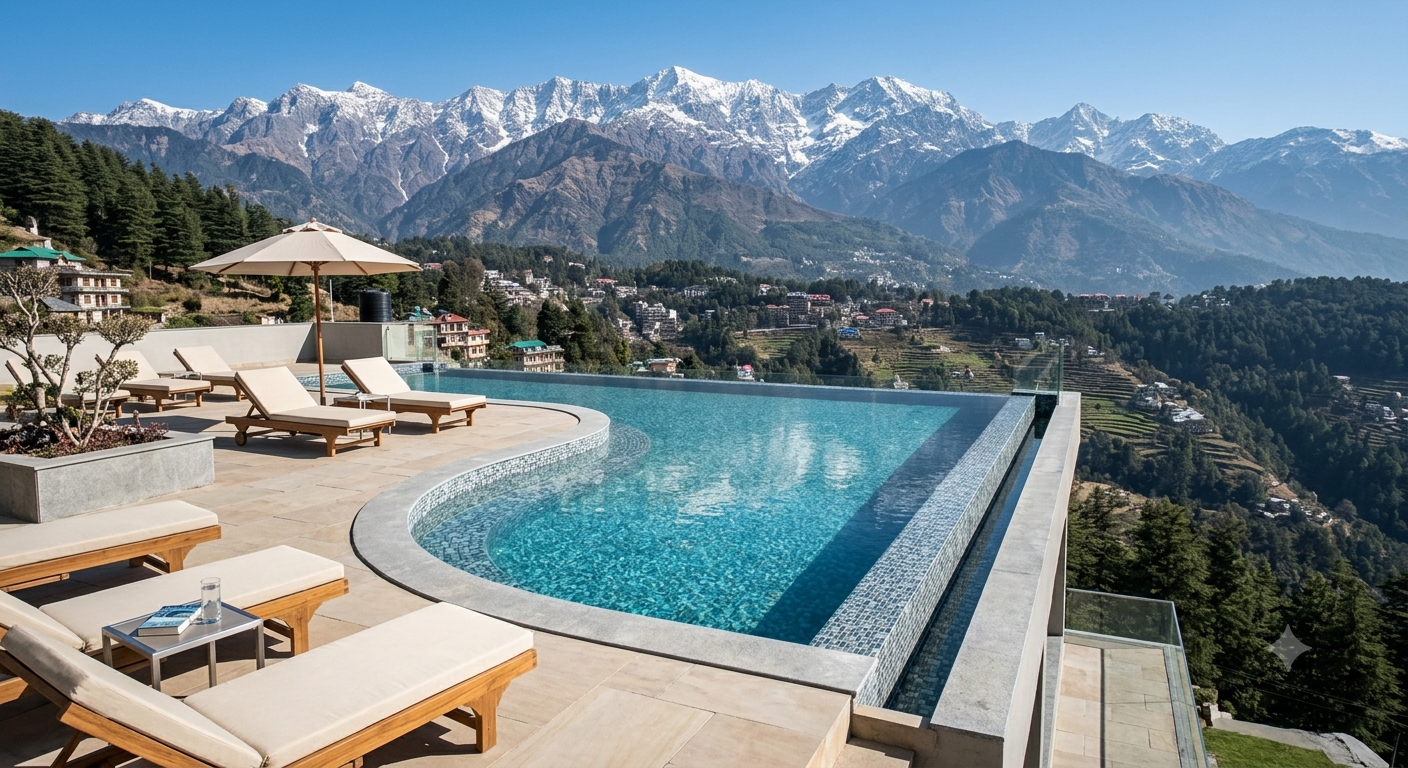
This guide covers three things in order: what drives cost, the build process, and hillside-specific design requirements — with direct comparisons on what most local contractors leave out of their proposals.
1. Cost: What Drives Infinity Pool Construction Cost in Dharamshala?
Infinity pool cost in Dharamshala is shaped by far more than pool size. Because almost no plot in this region is truly flat, the biggest cost variable is usually how much retaining or cantilever structure the terrain demands before a single tile is laid. A pool on a gentle 10-degree slope needs a very different foundation budget than one on a 30-degree drop toward the valley, and this is the single most common thing generic online calculators get wrong for hill-town clients.
The second major driver is edge type. A single-edge vanishing pool, where water spills over one side into a hidden catch basin, is structurally simpler and therefore more economical than a double-edge or wraparound infinity design, which needs a balance tank sized for overflow from multiple directions simultaneously. Resort and villa projects in Dharamshala increasingly ask for wraparound edges specifically to maximize the 270-degree mountain views available on ridge-line plots, which pushes both engineering complexity and cost upward.
Material finish is the third lever. Glass mosaic tiling gives the sharpest “infinity” visual effect because of its reflectivity, but it’s more expensive to install correctly on a curved or angled shell than pebble or quartz aggregate finishes. Natural stone coping, often sourced regionally in Himachal Pradesh, adds a premium but blends the pool edge into the surrounding hillside landscaping far better than poured concrete coping.
Finally, logistics matter more here than almost anywhere else in India. Material transport to elevated or narrow-access hill sites, limited crane and equipment access, and labor mobilization to remote plots all add real cost that a plains-based project simply doesn’t carry. If you’re comparing quotes against a mainstream Swimming Pool Construction Company in Delhi, expect the Dharamshala number to run higher for a similar-sized pool purely because of terrain and access, not because the finish quality is different.
What changes the price on hillside sites specifically:
-
- Retaining wall / cantilever structure for sloped plots (adds meaningfully over plains pricing)
-
- Soil-bearing capacity and geotechnical testing before design finalization
-
- Balance tank capacity upgraded for monsoon runoff
-
- Access logistics — material transport to hill sites adds to labor and equipment cost
- Finish: pebble/quartz vs. glass mosaic vs. natural stone coping
Most local providers quote a single flat number without breaking this down. Ask any builder to itemize structural work, waterproofing, filtration, and finishing separately before signing — it’s the fastest way to spot an underscoped quote.
2. Process: The Infinity Pool Construction Process, Step by Step
Building an infinity pool on hillside terrain follows the same broad sequence as any pool project — survey, design, excavate, build, waterproof, finish, commission — but each stage carries extra steps specific to sloped, high-rainfall, seismic-zone construction that most generic “how it’s built” content skips entirely.
Step 1 — Site survey & soil testing (1–2 weeks).
A geotechnical engineer assesses soil-bearing capacity, checks the water table, and maps the exact gradient across the proposed pool footprint. On hill plots, this survey also identifies natural drainage paths so the pool and its balance tank don’t end up fighting seasonal runoff. This is a step that urban builders working on flat NCR plots, like an Infinity Pool Builder Gurugram typically serves, can often shorten or skip — but skipping it on a Dharamshala hillside is the single biggest cause of later structural problems.
Step 2 — Structural design & seismic detailing (2–3 weeks).
The pool shell, cantilever extension, and any retaining structure are designed as reinforced concrete (RCC) elements with seismic detailing appropriate for Zone IV–V. This is where a structural engineer, not just a pool contractor, needs to sign off on the drawings. The design also fixes the pool’s orientation relative to the Dhauladhar range and the sun path, since infinity edges only deliver their visual effect when aligned correctly with the view.
Step 3 — Excavation & foundation (2–4 weeks).
Cut-and-fill earthwork is adjusted for the gradient, and foundation piling is added where soil-bearing capacity is marginal. On steep sites, this stage often takes longer than a plains-equivalent project because equipment access is constrained and excavated material has to be managed carefully to avoid destabilizing the slope below the build zone.
Step 4 — Shell construction (3–5 weeks).
The RCC pool shell, the vanishing-edge wall, and the balance tank are built together as one structural system — not as separate add-ons. The balance tank on a hillside monsoon-climate project is intentionally oversized compared to a similar pool built by a Swimming Pool Design Company Delhi for a flat urban plot, because it needs to absorb heavy seasonal rainfall inflow on top of normal pool overflow.
Step 5 — Waterproofing (1–2 weeks, plus cure time).
Multi-layer waterproofing is applied to handle sustained hydrostatic pressure from monsoon-saturated hill soil pushing against the shell from outside, in addition to normal pool-side water exposure from inside. This dual-direction pressure is unique to hillside construction and is frequently underspecified in generic waterproofing packages.
Step 6 — Plumbing & filtration (2 weeks).
Skimmer and overflow piping, the filtration and circulation system, and balance tank pump sizing are installed and pressure-tested. Filtration equipment for hill-altitude installations is also selected with power fluctuation and lower ambient temperatures in mind, since Dharamshala’s climate differs meaningfully from Delhi-NCR’s.
Step 7 — Tiling & finishing (2–3 weeks).
The chosen finish — mosaic, pebble, quartz, or natural stone — is applied to the shell and edge detailing, along with coping that’s selected to visually integrate with the surrounding hillside landscape rather than look transplanted from a city villa.
Step 8 — Commissioning (3–5 days).
The pool is filled, water chemistry is balanced, filtration is tested under real load, and the client receives a full maintenance walkthrough covering monsoon-specific care.
3. Hillside Design Guide: Why Dharamshala Construction Differs From Plains Construction
Most pool-builder websites reuse generic “infinity pool” content written for flat, plains-based cities. Dharamshala’s terrain, climate, and seismic zone change the engineering brief entirely, and this section covers the gap most competitor pages don’t address.
Slope and cantilever engineering.
Dharamshala properties are rarely flat. An infinity edge on a hillside plot usually requires a cantilevered pool shell extending over a retaining structure, not a simple weir wall. This needs a structural engineer’s sign-off, not just a pool contractor’s estimate, and the cantilever’s load calculations have to account for the full water weight plus seismic lateral forces simultaneously — a combination that a firm specializing purely in a Luxury Swimming Pool Builder Delhi portfolio may not have direct hill-terrain experience calculating.
Seismic Zone V considerations.
Himachal Pradesh sits largely in Seismic Zone IV–V, among the highest-risk zones in India. Pool shells, catch basins, and retaining walls need reinforced RCC design with seismic detailing — flexible joints, appropriate rebar spacing, and foundation ties that account for lateral ground movement. This is a step many “infinity pool” quotes circulating in this region simply skip, because the contractor’s standard design template was built for lower-risk zones.
Monsoon-grade waterproofing.
Dharamshala receives some of the highest rainfall in India, often exceeding 3,000mm annually. Waterproofing has to handle sustained hydrostatic pressure from saturated hill soil pushing against the pool shell and balance tank from the outside — not just splashing and chemical exposure from the inside, which is what most standard waterproofing systems are rated for.
Balance tank and drainage sizing.
Vanishing-edge pools need a catch basin sized for heavy monsoon inflow plus normal overflow. Undersized balance tanks are the single most common cause of infinity pool failure in high-rainfall hill towns — water either overtops the tank during heavy rain or, at the other extreme, the pump cycles dry during low-rainfall months if the system wasn’t sized with seasonal variation in mind.
View orientation and structural placement.
The entire purpose of an infinity edge is the view it frames. Placement has to be planned around Dhauladhar sightlines, sun path through the day, and prevailing wind direction — not simply positioned wherever the plot happens to be flattest, which is often the default approach on lower-effort projects.
Materials suited to altitude and climate.
Hill-altitude installations see wider temperature swings and higher humidity than Delhi-NCR sites. Filtration equipment, pump housings, and electrical fittings are specified with weatherproofing and altitude tolerance in mind, and finish materials are chosen for freeze-thaw resistance during colder months — a consideration that simply doesn’t apply to a Swimming Pool Construction Company in Delhi building on the plains.
Infinity Pool vs. Skimmer Pool: Which Suits a Dharamshala Property?
| Factor | Infinity (Vanishing-Edge) Pool | Standard Skimmer Pool |
| Best for | View-facing hillside plots | Flat plots, budget builds |
| Structural complexity | High — needs cantilever/retaining design | Low to moderate |
| Relative investment | Higher than a comparable skimmer pool | Baseline |
| Monsoon drainage needs | Balance tank sized for heavy runoff | Standard skimmer sizing |
| Visual effect | Water appears to merge with the mountain horizon | Water stays within visible pool edge |
4. Maintenance: Caring for an Infinity Pool in a High-Rainfall Hill Climate
Maintenance requirements for an infinity pool in Dharamshala differ from both standard plains-based pools and infinity pools in drier climates, mainly because of the monsoon cycle and altitude.
Pre-monsoon and post-monsoon balance tank service.
The balance tank should be inspected and cleared of debris before the monsoon season begins, and again immediately after it ends, since heavy rainfall inflow carries silt and organic debris that can clog pumps if left unchecked. This is a maintenance step most plains-based pools, and the guidance offered by a typical Infinity Pool Builder Gurugram, don’t need to emphasize to the same degree.
Annual waterproofing inspection.
Because the pool shell experiences hydrostatic pressure from saturated hill soil for several months a year, an annual waterproofing check is recommended to catch any early-stage seepage before it becomes a structural issue rather than a cosmetic one.
Filtration and equipment checks.
Pumps and filtration systems should be checked more frequently during and after monsoon season, both for debris load and for any power-fluctuation-related wear, which is more common in hill-town electrical infrastructure than in metro areas.
Water chemistry balancing.
Rainfall dilutes pool chemistry rapidly during monsoon months, so chemical balancing needs to happen on a tighter schedule during that period compared to the dry season.
Structural and coping inspection.
Given the seismic zone and cantilever structure, an annual visual and, ideally, engineering inspection of the retaining structure and coping joints is worth the cost — catching minor settlement early is far cheaper than remedial structural work later.
Why Choose Us for Infinity Pool Construction in Dharamshala
-
- In-house structural engineering for sloped and seismic-zone sites — not outsourced after the quote
-
- Monsoon-rated waterproofing systems tested for sustained hydrostatic pressure
-
- Transparent, itemized costing — structural, waterproofing, filtration, and finishing quoted separately
-
- Site-specific design around Dhauladhar view corridors and sun orientation
-
- End-to-end project management from soil testing to commissioning
Frequently Asked Questions
What determines the cost of an infinity pool in Dharamshala?
Cost is driven primarily by pool size, edge type, and how much retaining or cantilever structure the site’s slope requires — hillside plots typically need more structural work than flat plains sites, which affects the final investment. A site survey is the only reliable way to get an accurate figure.
How long does infinity pool construction take?
Most projects take 10 to 20 weeks from the initial site survey and soil testing through to handover, with hillside sites at the longer end due to structural and access requirements.
Can an infinity pool be built on a sloped hill plot?
Yes. Sloped plots are actually common in Dharamshala and are handled with a cantilevered pool shell supported by an engineered retaining structure, designed after a geotechnical soil survey.
Is infinity pool construction safe in a seismic zone like Himachal Pradesh?
Yes, when the pool shell and retaining structure are designed with seismic detailing appropriate for Zone IV–V, using reinforced RCC construction and a structural engineer’s sign-off — not a standard plains-area design.
What maintenance does an infinity pool need in a high-rainfall climate?
Balance tank cleaning before and after monsoon season, filtration system checks, annual waterproofing inspection, and tighter water-chemistry balancing during monsoon months — hill-climate pools need more frequent balance tank checks than plains pools due to rainfall runoff.
What’s the difference between an infinity pool and a normal swimming pool?
An infinity pool has one or more edges where water flows over into a hidden catch basin, creating a visual effect where the pool appears to blend into the horizon or landscape — a standard pool has a fixed visible edge on all sides.
Do I need a structural engineer for infinity pool construction, or just a pool contractor?
On hillside and seismic-zone sites like Dharamshala, yes — a structural engineer needs to sign off on the cantilever and retaining structure design in addition to the pool contractor’s build plan. This is different from flat-plot construction, where a pool contractor’s in-house design is often sufficient.