
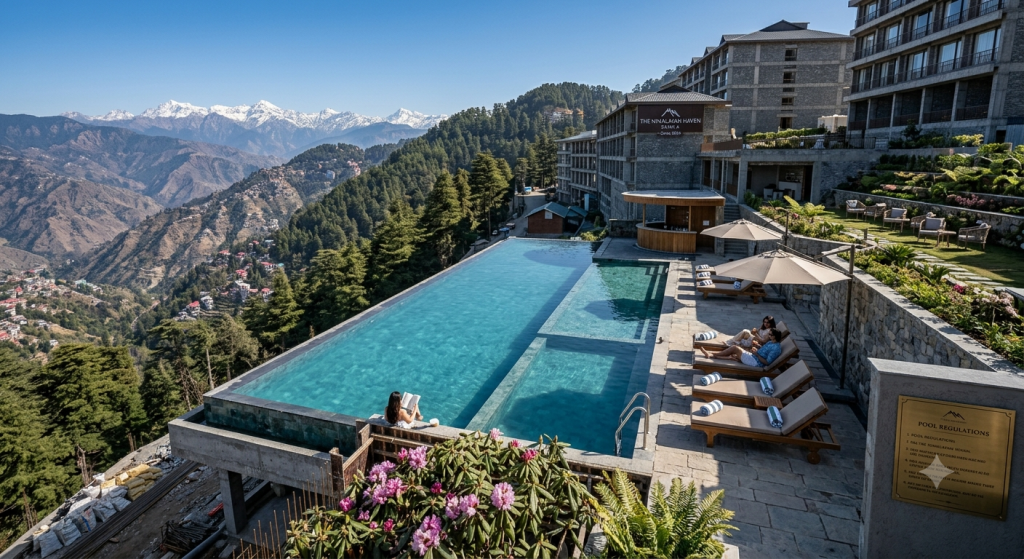
Kristo Pool provides Hotel Swimming Pool Construction in Shimla for boutique hotels, heritage properties, and resorts, specializing in cold-climate engineering — freeze-resistant waterproofing, altitude-rated structural design, and heated pool systems built for sub-zero winters. Projects cover Mall Road, Chhota Shimla, Naldehra, Kufri, and Mashobra.
What Is Hotel Swimming Pool Construction in Shimla?
Hotel swimming pool construction in Shimla is the process of designing and building a commercial-grade pool for a hotel property in hill-station conditions — accounting for steep slopes, rocky foundations, freeze-thaw winters, and limited water supply. Unlike plains construction, it requires cold-climate-rated waterproofing, reinforced RCC shells, and built-in heating, since unheated pools are only usable a few months a year at this altitude. Kristo Pool delivers this as a full-service build: site survey, structural design, waterproofing, filtration, heating, and compliance sign-off.
Why Do Hill-Station Hotels Need Specialist Pool Builders?
Standard plains-grade pool construction fails in Shimla within one to two seasons because it isn’t built for the local climate and terrain. Specialist construction addresses:
- Freeze-thaw cracking — standard concrete and tiling crack under temperature swings; Kristo Pool uses cold-climate-rated waterproofing membranes and expansion joints instead.
- Slope and soil instability — hill terrain requires a site survey for slope stability and soil-bearing capacity before design begins.
- Water scarcity — many Shimla hotels rely on tanker supply, so filtration and backwash systems are designed to minimize water wastage and recycle backwash water.
- Limited swimming season — solar-assisted heat pumps extend usability beyond the few unheated months Shimla’s climate allows.
- Regulatory compliance — municipal NOCs, fire safety clearances, and structural stability certificates are required before a hotel pool can legally open to guests.
How Long Does Hotel Pool Construction Take in Shimla?
Timelines depend on pool size, site access, and terrain, but Kristo Pool plans construction around a hotel’s low-occupancy season so the build doesn’t disrupt guest bookings. Hill-terrain projects generally take longer than plains equivalents because of restricted material access and phased delivery schedules.
What Does Hotel Pool Construction Cost in Shimla?
Cost varies significantly by terrain, water access, and pool size, so Kristo Pool does not quote a flat price without a site visit. Every project starts with a free feasibility assessment covering soil testing, drainage planning, and a realistic budget range before construction begins — because a generic price estimate rarely holds once actual site conditions are surveyed.
Hotel Swimming Pool Construction Chandigarh
Hotel swimming pool construction in Chandigarh differs from Shimla because of flat terrain, year-round usage, and business-travel-driven demand. Chandigarh pools are typically designed for higher daily footfall, open-air leisure use, and rooftop or poolside event spaces, with faster construction timelines thanks to easier municipal water and power access. Kristo Pool delivers Hotel Swimming Pool Construction in Chandigarh using filtration and turnover-rate specifications sized for longer swimming seasons and heavier guest usage — a different engineering brief from cold-climate hill projects. Hotel groups with properties in both regions should not reuse one city’s pool design for the other: soil conditions, climate loads, and guest usage patterns differ enough that a copied blueprint typically fails. Kristo Pool treats each site as an independent engineering problem and is often brought in during early property planning — before architectural drawings are finalized — so pool placement and structural loading are accounted for from day one.
What Are the Core Stages of Hotel Swimming Pool Construction?
Every Hotel Swimming Pool Construction project follows five core stages, regardless of location:
- Structural design — in-ground RCC, raised deck, or modular shell, chosen by cost, timeline, and load-bearing needs.
- Waterproofing — membrane and expansion-joint specification matched to local climate.
- Filtration and water treatment — sand, cartridge, or DE filters, selected for water clarity and maintenance load.
- Tiling and finishing — mosaic, pebble-finish plaster, or fibreglass, balancing aesthetics against slip resistance and repair frequency.
- Mechanical systems — heating and circulation, sized to guest usage and climate.
Kristo Pool also builds in guest safety compliance, accessibility ramps where required, and pool-deck drainage for monsoon runoff, since most Indian hotel pools are outdoor or semi-outdoor.
Why Standard Pool Waterproofing Fails in Hill Stations
Most pool construction failures in Shimla aren’t caused by bad workmanship — they’re caused by using plains-grade waterproofing in a climate it was never designed for. If you’re evaluating Hotel Swimming Pool Construction in Shimla, understanding this failure mode is the difference between a pool that lasts fifteen years and one that needs resurfacing every other winter.
The Freeze-Thaw Problem
Water expands by roughly 9% when it freezes. In a standard plains-grade waterproofing membrane, moisture that gets trapped in microscopic pores or hairline cracks freezes overnight during Shimla’s winter, expands, and widens the crack. Thaw during the day, refreeze at night — repeat that cycle for a few months and a membrane rated for stable, warmer climates simply doesn’t hold. This is called freeze-thaw cracking, and it’s the single most common reason hill-station pools fail early.
Where Standard Construction Cuts Corners
Three shortcuts show up repeatedly in hill-station pools built with plains-grade specifications:
- Membrane selection — using standard bituminous or cementitious waterproofing rated for stable temperatures, instead of elastomeric or cold-climate-rated membranes designed to flex under temperature swings.
- Expansion joints — skipping or under-specifying expansion joints, which are what allow the pool shell to move slightly with temperature change without cracking the waterproofing layer.
- Insufficient curing time — rushing construction in a compressed tourist-season window, without allowing concrete and waterproofing layers to cure properly before the first freeze cycle hits.
What Correct Hill-Climate Waterproofing Looks Like
A properly specified hill-station pool uses waterproofing membranes rated for repeated freeze-thaw cycling, reinforced expansion joints placed at calculated intervals around the shell, and a curing schedule that accounts for Shimla’s shorter dry-weather construction window. None of this is exotic technology — it’s standard practice in genuinely cold-climate construction, but it’s frequently skipped by contractors who default to plains specifications because that’s what they know, or because it’s cheaper to quote.
The Real Cost of Getting This Wrong
A cracked waterproofing membrane doesn’t just mean cosmetic tile damage — water seeping behind the shell can undermine structural reinforcement, cause efflorescence and staining, and in the worst cases, lead to slope or foundation movement on already unstable hill terrain. Repair costs for a failed hill-station pool routinely exceed what correct waterproofing would have cost at the outset, which is why cutting this corner rarely actually saves money over the pool’s lifetime.
Getting It Right the First Time
Kristo Pool specifies cold-climate-rated waterproofing systems as standard on every Hotel Swimming Pool Construction Shimla project — not as a premium upgrade, but as the baseline required for a hill-station pool to survive its first few winters intact.
Hotel Swimming Pool Construction Mussoorie
Hotel swimming pool construction in Mussoorie faces the same core challenges as Shimla — steep gradients, seasonal tourism, and cold-weather protection — but with narrower access roads that require smaller machinery and phased material delivery. Kristo Pool delivers Hotel Swimming Pool Construction in Mussoorie using the same cold-climate waterproofing and heating specifications proven in Shimla, adapted to each site’s slope angle and soil type. For hotel groups operating across the Himalayan hill circuit — Shimla, Mussoorie, and increasingly Manali or Dharamshala — this shared engineering approach means faster design turnaround on each additional property, since core specifications are already validated rather than redeveloped from scratch.
Frequently Asked Questions
Does a hotel pool need to be heated in Shimla?
Yes. Shimla’s climate only supports unheated swimming for a few months a year, so most hotel pools use solar-assisted heat pumps to extend the usable season and justify the investment as a year-round guest amenity.
Can an existing hotel pond or water body be converted into a swimming pool?
Conversion is possible, but it requires structural assessment, updated waterproofing, and filtration retrofitting to meet safety and hygiene standards — it is rarely a simple conversion.
What permits are required for a hotel swimming pool in Shimla?
Hotels generally need a municipal corporation NOC, fire safety clearance, and a structural stability certificate before the pool can legally open to guests.
Is Kristo Pool’s Shimla design usable for a Chandigarh or Mussoorie property?
No. Each region needs its own engineering plan — Chandigarh’s flat terrain and longer swimming season and Mussoorie’s steep access roads both require different structural and filtration specifications than Shimla.
How do I get a cost estimate for hotel pool construction?
Kristo Pool provides a free site visit and feasibility report — covering soil testing, drainage, and budget range — since accurate pricing depends on site conditions, not a generic quote.